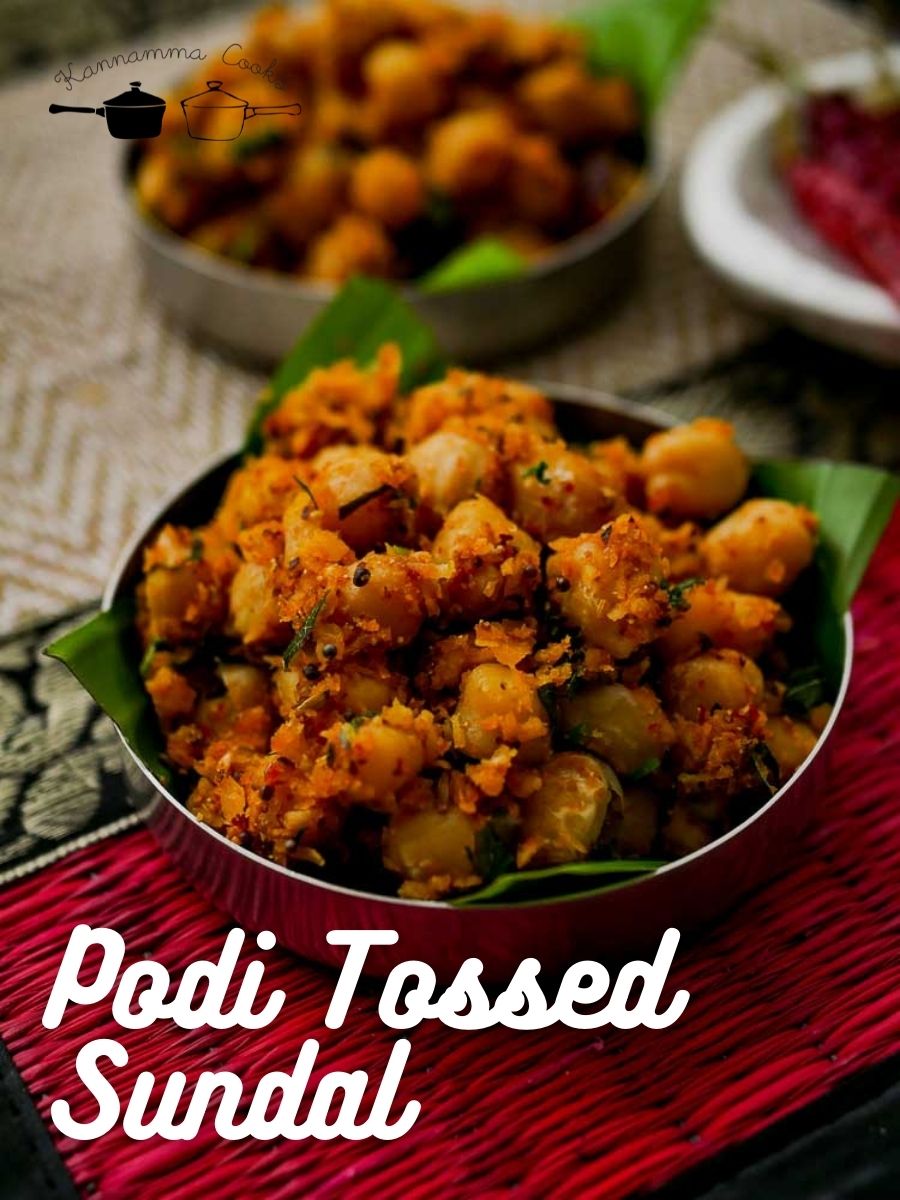
Recipe for sundal made with chickpeas tempered with a homemade powder and coconut. Simple and delicious chickpea sundal recipe with video.
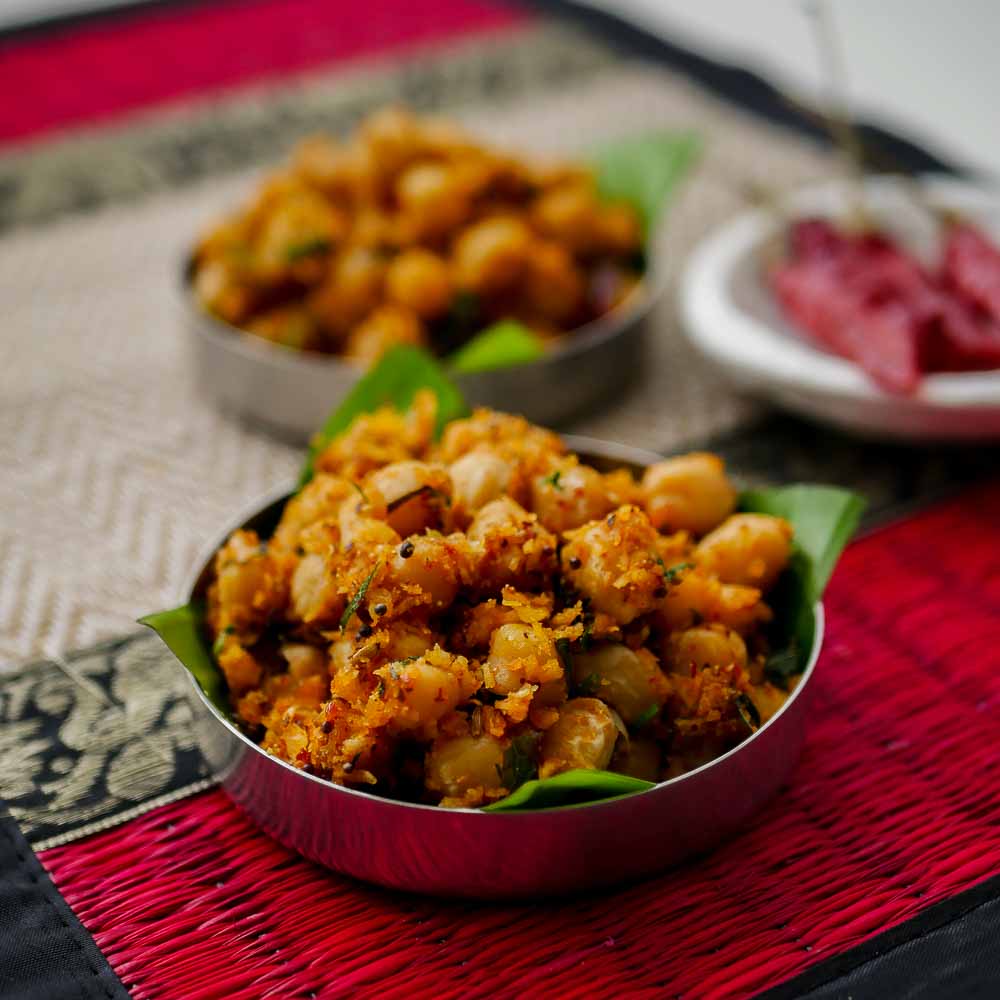
The festival season is here and sundal reigns supreme in all homes as its Navrathri. This podi tossed sundal is my favorite. A masala powder is made by roasting chana dal and spices in sesame oil. The roasted spices is then ground to a powder. This powder is mixed with cooked chickpeas and tempered in oil. Do try this recipe for this season.
I have used dry chickpeas that has been soaked and cooked for making this sundal. If you are in a hurry, canned chickpeas will work just fine. You can make the podi / masala powder in bulk and store it in the freezer and use the podi to make sundals, to sprinkle in veggies etc… I have made this podi tossed sundal today using chickpeas. Black chickpeas, Black eyed peas, horsegram can be used too. For spice – heat, I have used only dry red chillies. For a variation, you can also use green chillies while tempering. Adjust the chillies according to your taste and preferences.
Here are some of the products used in this recipe that you can buy online Heavy Duty Indian Mixie https://amzn.to/3oHbbAM Triply Pan https://amzn.to/3iFOOb6 Chickpeas https://amzn.to/2WP7mxJ Idhayam sesame oil https://amzn.to/2WQLaDr
Here is the video of how to make Podi Potta Sundal – Podi Tossed Sundal Recipe
For the Masala Powder (Podi)
1 teaspoon Indian sesame oil 2 teaspoon coriander seeds 3 dried red chillies 1.5 tablespoon chana dal
For Tempering the Sundal
2 teaspoon Indian sesame oil 1/2 teaspoon mustard seeds 1/2 teaspoon cumin seeds 3 pieces dried red chillies 1.5 tablespoon curry leaves, finely chopped 1/4 teaspoon asafoetida 3/4 teaspoon salt 1/4 teaspoon sugar 1/2 cup fresh shredded coconut 2 tablespoon coriander leaves, finely chopped 2 teaspoon lime juice
Cooking the chickpeas
Soak a cup of chickpea overnite in water. Drain the water and add it to a pressure cooker. Add 2 cups water and cook the chickpeas for 12 minutes. Ignore the number of whistles. Open after the pressure settles. Drain the chickpeas and set aside.
Now we will make a podi / powder. Heat Idhayam sesame oil in a pan and add in the coriander seeds and the dry red chillies. Roast on a low flame until golden. Remove the roasted spices and set aside. In the same oil, add in the chana dal. Roast on a low flame till the chana dal is golden. Remove the chana dal. Grind everything to a dry powder. Set aside.
Tempering the sundal
Heat sesame oil in a pan and add in the mustard seeds, cumin seeds and dry red chillies. Add in the finely chopped curry leaves. Let the mustard seeds crackle. Add in the asafoetida and saute for a few seconds.
Add in the cooked and drained chickpeas. Mix well to combine. Saute for a minute. Add in the salt, sugar and the powder. Mix well to combine. Add in the fresh shredded coconut. That little sugar nicely balances the savoury taste of the powder.
Finally add in the coriander leaves and lime juice. After adding the lime juice, do not cook. Switch off the flame immediately and mix well to combine. Cooking the lime / lemon juice makes it bitter. I like to add lime juice as the acidity gives a nice freshness in every bite of the sundal.
Serve.
- Author: Suguna Vinodh
- Prep Time: 8h
- Cook Time: 30m
For the Masala Powder (Podi)
1 teaspoon Indian sesame oil 2 teaspoon coriander seeds 3 dried red chillies 1.5 tablespoon chana dal
For Tempering the Sundal
2 teaspoon Indian sesame oil 1/2 teaspoon mustard seeds 1/2 teaspoon cumin seeds 3 pieces dried red chillies 1.5 tablespoon curry leaves, finely chopped 1/4 teaspoon asafoetida 3/4 teaspoon salt 1/4 teaspoon sugar 1/2 cup fresh shredded coconut 2 tablespoon coriander leaves, finely chopped 2 teaspoon lime juice
Cooking the chickpeas
Soak a cup of chickpea overnite in water. Drain the water and add it to a pressure cooker. Add 2 cups water and cook the chickpeas for 12 minutes. Ignore the number of whistles. Open after the pressure settles. Drain the chickpeas and set aside.
Now we will make a podi / powder. Heat Idhayam sesame oil in a pan and add in the coriander seeds and the dry red chillies. Roast on a low flame until golden. Remove the roasted spices and set aside. In the same oil, add in the chana dal. Roast on a low flame till the chana dal is golden. Remove the chana dal. Grind everything to a dry powder. Set aside.
Tempering the sundal
Heat sesame oil in a pan and add in the mustard seeds, cumin seeds and dry red chillies. Add in the finely chopped curry leaves. Let the mustard seeds crackle. Add in the asafoetida and saute for a few seconds.
Add in the cooked and drained chickpeas. Mix well to combine. Saute for a minute. Add in the salt, sugar and the powder. Mix well to combine. Add in the fresh shredded coconut. That little sugar nicely balances the savoury taste of the powder.
Finally add in the coriander leaves and lime juice. After adding the lime juice, do not cook. Switch off the flame immediately and mix well to combine. Cooking the lime / lemon juice makes it bitter. I like to add lime juice as the acidity gives a nice freshness in every bite of the sundal.
Serve.
- Author: Suguna Vinodh
- Prep Time: 8h
- Cook Time: 30m
Find it online : https://www.kannammacooks.com/podi-tossed-sundal/

Neem is a popular Indian tree found abundantly in all parts of the Indian subcontinent. It’s a versatile tree that has grown on our land since time immemorial and has been used for a variety of purposes since prehistoric times. Different parts of the neem tree have been used in Indian homes for many purposes such as ‘daatun’ for brushing teeth, moth-repellent in clothes to treat acne, wounds, and allergies. It has also been widely used in traditional medicine and home remedies for the treatment of several ailments for its medicinal properties.
Recently utensils and kitchenware made from neem wood have made a comeback. The trend is not something new and is actually only a revival of the age-old practice of using wooden utensils for cooking and serving food in Indian kitchens. But now that we have materials such as metals, glass, and plastic widely available, why go back, you would ask – why use Neem wood kitchenware? Does neem wood offer any special benefits? Does neemwood kitchenware possess all the qualities the wood is claimed to contain? Read on to find out.
Neem – the wonder wood In Indian culture, neem is considered auspicious and is worshipped as a sacred tree. In Sanskrit, neem is arista, meaning something that is perfect, imperishable, and complete – believed to bring the boon of good health. So as tradition, every home in olden times had a neem tree in its courtyard.
Neem also has a long-standing use in the ancient science of traditional medicine that offers cures to illnesses such as arthritis, malaria and infections, and skin ailments. Neem is known to possess a host of therapeutic and medicinal properties that have not only been backed by ancient Ayurveda but modern studies as well. Neem tree is known to have more than 130 different biologically active compounds such as nimbis and nimandial, which help heal the body and promote healthy living.
Neem wood is thus specifically an ideal choice for making utensils, spoons, ladles, and serve-ware for kitchen use. Let’s look at some of the qualities and Neem wood kitchenware benefits:
Neem Wood Kitchenware Benefits It is the property of wood that is a poor conductor of heat, however, Neem is not just heat resistant but is also ‘Sheet’ and ‘Vranhar’, i.e. cool and healing in its natural properties.
Neem wood is also ‘Krumihar’ or antimicrobial, anti-germicidal, antibacterial, and antifungal, which is why it was traditionally used in medicines, for brushing teeth and eating food, etc.
Neemwood contains natural pesticidal properties that inhibit the growth of bacterias and fungi and makes it resistant to pests such as wood borers and termites.
Neem bark is known to possess antiseptic and astringent properties that help heal wounds owing to which it was used in Ayurvedic medicines. As a natural antiseptic, kitchenware made from Neem wood is non-toxic, unlike plastic and Teflon-coated utensils that have been found to be cancer-causing.
It is a physical property of Neem wood that is resistant to moisture and can withstand wet use in the kitchen for a long time. Neem heartwood is a very hard, strong, and durable material. It does not splinter easily and is resistant to wear and tear. It has a slightly rough texture with interlocking fibers and is, therefore, ideal for items like cutting boards, etc, and does not scratch easily despite repeated cutting. Even if some tiny bits of neem wood or extracts are ingested they have the ability to destroy parasites present in the body and fend off illnesses owing to their natural properties.
Traditionally handcrafted Neem utensils All the above-mentioned qualities make neem wood a fine choice and ideal for use in the kitchen. To make utensils and other items, Neem wood is handcrafted by artisans with a process that preserves the amazing qualities of neem wood while giving it beautiful, usable shapes. Handcrafted neemwood utensils are so rich in all the therapeutic qualities of neem plus aesthetically pleasing and highly functional.
The process of crafting utensils from neem wood involves using the bark and heartwood of mature neem trees. The bark and heartwood are soaked in water briefly and then dried, however without exposure to the sun as that can split the wood. The wood is soaked again and then machine-cut into slices to make boards. It is finally dried, and hand scrubbed and sculpted by skilled artisans into beautiful products such as neem wood kitchen set , utensils and tools such as spoons and ladles, and furniture, etc.
Conclusion Neem wood utensils and kitchenware were found and used in every home before they were replaced by plastic and metal utensils that have been found to be hazardous to health by several studies. Natural neem wood is a safe and better alternative that not only fulfills functional purposes but also ushers in a wealth of health benefits with its use.
Now, don’t you think it would be a great idea to invest in a neem wood kitchen set for your kitchen and dining room for use every day? Aesthetically crafted neem wood kitchenware would also make a beautiful addition to your home!
Article contributed by Sandeep Singh
