
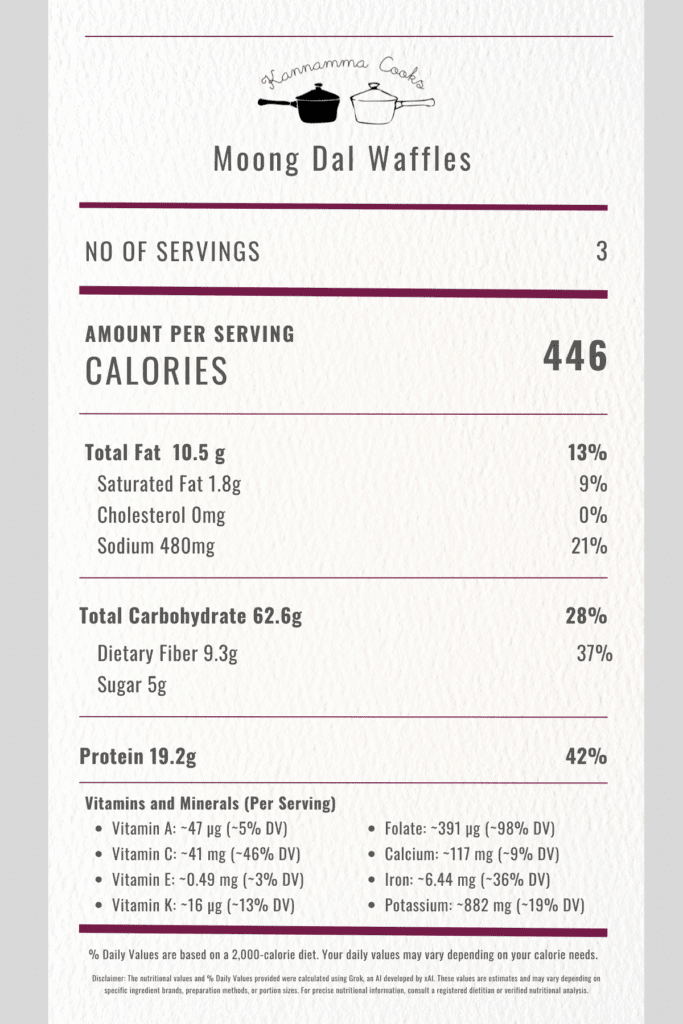
Golden, crispy Moong Dal Waffles—packed with fiber and protein. One tasty way to keep healthy eating exciting.
Moong dal (a legume) and rice (a grain) complement each other in amino acid profile: dal is high in lysine but low in methionine, while rice is high in methionine but low in lysine. Together, they provide all nine essential amino acids in sufficient amounts, making this dish a complete protein.
The addition of potatoes bring that irresistible crunch. Perfect for breakfast, a snack, or even a light dinner — healthy eating never tasted this good!
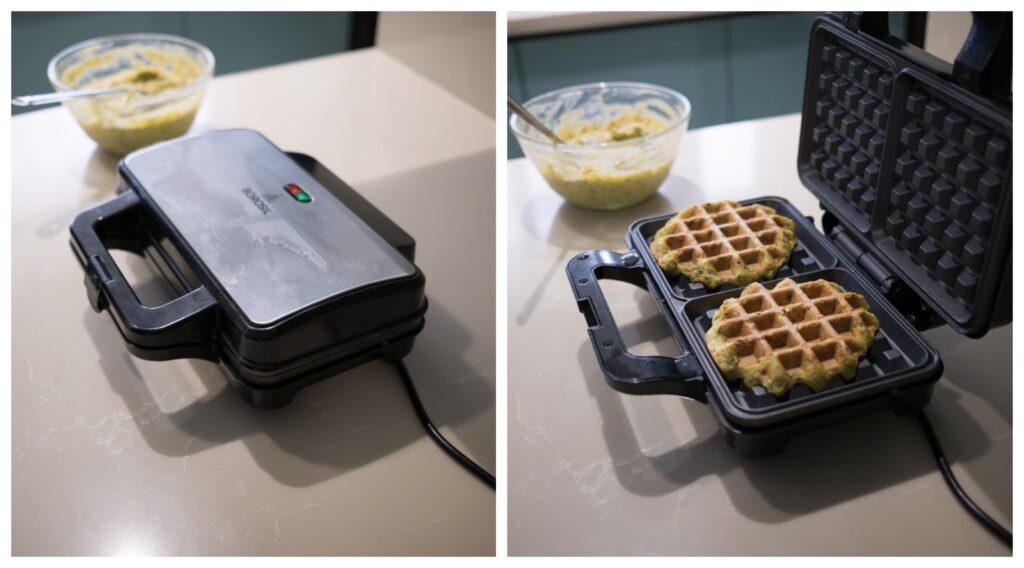
I have used my Borosil Waffle Iron for making this recipe. I have a two grid waffle maker. Borosil also has a four waffle maker. If you have a big family, buying a four grid waffle maker will help as it takes time for each batch to cook.
Two grid waffle maker https://amzn.to/3Ukddp5 Four grid waffle maker https://amzn.to/45Ji3T4
Prep

Wash the moong dal and rice in several changes of water until the water runs clear. Place it in a bowl, cover with water, and soak for 2–3 hours. Drain both the dal and rice after soaking. Place the soaked dal and rice in a wet grinder or blender along with green chillies, chopped ginger, curry leaves, asafoetida, turmeric powder, and salt. Grind to a smooth, fine paste, adding just enough water to keep the blades moving. Avoid adding too much water so the batter remains thick. Transfer the paste to a large mixing bowl.

Add the grated boiled potatoes, chopped onions, coriander, mint, sesame seeds, cumin seeds, sugar, and baking soda to the ground paste. Mix well so that all the ingredients are evenly distributed. If the batter feels too thick to spread, add a little water until it reaches a thick chutney-like consistency—spreadable but not runny.

Making the waffles
Preheat the waffle iron according to the manufacturer’s instructions. Lightly grease both plates with vegetable oil using a pastry brush or folded paper towel. Place a scoop of batter in the center of the hot waffle iron and gently spread it to fill the grid. Close the lid and cook until the waffles are golden brown and crisp. Avoid opening the lid too early to prevent the waffles from breaking. Mine took almost 12-13 minutes in my borosil waffle iron. It might take little less time in a heavy duty waffle maker.

Carefully remove the waffle using silicone tongs or a spatula. Repeat with the remaining batter, lightly greasing the plates before each batch. Serve the waffles hot, either plain or with plain yogurt on the side.


For grinding
3/4 cup moong dal 1/4 cup raw rice 3 green chillies ½ -inch ginger, chopped 2 sprigs curry leaves. chopped 1/4 teaspoon asafoetida 1/2 teaspoon turmeric powder 3/4 teaspoon salt
Other Ingredients
2 potatoes, boiled and grated 1 cup onions, finely chopped 4 sprigs coriander leaves, finely chopped 4 sprigs mint leaves, finely chopped 1 tablespoon sesame seeds 1/2 teaspoon cumin seeds 1 teaspoon sugar 1/4 teaspoon baking soda 2 teaspoon vegetable oil
Prep
Wash the moong dal and rice in several changes of water until the water runs clear. Place it in a bowl, cover with water, and soak for 2–3 hours. Drain both the dal and rice after soaking. Place the soaked dal and rice in a wet grinder or blender along with green chillies, chopped ginger, curry leaves, asafoetida, turmeric powder, and salt. Grind to a smooth, fine paste, adding just enough water to keep the blades moving. Avoid adding too much water so the batter remains thick. Transfer the paste to a large mixing bowl. Add the grated boiled potatoes, chopped onions, coriander, mint, sesame seeds, cumin seeds, sugar, and baking soda to the ground paste. Mix well so that all the ingredients are evenly distributed. If the batter feels too thick to spread, add a little water until it reaches a thick chutney-like consistency—spreadable but not runny.
Making the waffles
Preheat the waffle iron according to the manufacturer’s instructions. Lightly grease both plates with vegetable oil using a pastry brush or folded paper towel. Place a scoop of batter in the center of the hot waffle iron and gently spread it to fill the grid. Close the lid and cook until the waffles are golden brown and crisp. Avoid opening the lid too early to prevent the waffles from breaking. Mine took almost 12-13 minutes in my borosil waffle iron. It might take little less time in a heavy duty waffle maker. Carefully remove the waffle using silicone tongs or a spatula. Repeat with the remaining batter, lightly greasing the plates before each batch. Serve the waffles hot, either plain or with plain yogurt on the side.
- Author: Suguna Vinodh
- Prep Time: 3 hours
- Cook Time: 60 minutes
For grinding
3/4 cup moong dal 1/4 cup raw rice 3 green chillies ½ -inch ginger, chopped 2 sprigs curry leaves. chopped 1/4 teaspoon asafoetida 1/2 teaspoon turmeric powder 3/4 teaspoon salt
Other Ingredients
2 potatoes, boiled and grated 1 cup onions, finely chopped 4 sprigs coriander leaves, finely chopped 4 sprigs mint leaves, finely chopped 1 tablespoon sesame seeds 1/2 teaspoon cumin seeds 1 teaspoon sugar 1/4 teaspoon baking soda 2 teaspoon vegetable oil
Prep
Wash the moong dal and rice in several changes of water until the water runs clear. Place it in a bowl, cover with water, and soak for 2–3 hours. Drain both the dal and rice after soaking. Place the soaked dal and rice in a wet grinder or blender along with green chillies, chopped ginger, curry leaves, asafoetida, turmeric powder, and salt. Grind to a smooth, fine paste, adding just enough water to keep the blades moving. Avoid adding too much water so the batter remains thick. Transfer the paste to a large mixing bowl. Add the grated boiled potatoes, chopped onions, coriander, mint, sesame seeds, cumin seeds, sugar, and baking soda to the ground paste. Mix well so that all the ingredients are evenly distributed. If the batter feels too thick to spread, add a little water until it reaches a thick chutney-like consistency—spreadable but not runny.
Making the waffles
Preheat the waffle iron according to the manufacturer’s instructions. Lightly grease both plates with vegetable oil using a pastry brush or folded paper towel. Place a scoop of batter in the center of the hot waffle iron and gently spread it to fill the grid. Close the lid and cook until the waffles are golden brown and crisp. Avoid opening the lid too early to prevent the waffles from breaking. Mine took almost 12-13 minutes in my borosil waffle iron. It might take little less time in a heavy duty waffle maker. Carefully remove the waffle using silicone tongs or a spatula. Repeat with the remaining batter, lightly greasing the plates before each batch. Serve the waffles hot, either plain or with plain yogurt on the side.
- Author: Suguna Vinodh
- Prep Time: 3 hours
- Cook Time: 60 minutes
Find it online : https://www.kannammacooks.com/moong-dal-waffles/
India was once perceived to be primarily a back office to the likes of the technology magnates in the world. This is no longer true. What was originally an outsourcing of IT support has grown into something much bigger and more influential. The startup ecosystem in India is one of the most vibrant ones in the world today. The industry now counts Tier 2-based software teams going global to tiny tech startups that have become billion-dollar unicorns in Bengaluru, to yet another big-ticket in Tech, which is industry-based.
The Journey from Service Center to Startup Capital
The development of this change was not something that happened overnight. A combination of youth, digital infrastructure, and a mobile-first population formed the foundations. There was a massive increase in App usage in India, not only in productivity and entertainment, but also in industries such as sports and games. The MelBet app is one of these examples. It is already popular among Indian users due to an easy-to-understand interface and the possibility to use it on a mobile device, which is the trend in the creation of digital products in India as well.
Back in the early 2000s, India’s most significant tech win was its ability to offer cost-effective services. Global firms outsourced customer support, coding, and data management to Indian teams. Over time, the country’s engineers went from executing tasks to designing solutions. The result? This is a new breed of Indian startups led by an Indian generation of founders, creating products not only in India but also around the globe.
What Made It All Click?
Beyond digital payment and online learning businesses, AI tools and logistics automation are some areas of future work that are happening in India and are already pursued by most technology companies. Many people also welcome real-time digital participation. As an example, it is possible to consider one of such platforms, i.e., MelBet India , which now represents a larger tendency: the conversion of a user into an active participant and not a passive consumer.
In the first place, the Indian mobile revolution was both fast and wide-reaching. The transformation of the internet has been made available through the creation of affordable data and affordable smartphones; all it took was days to reach the masses. Second, the number of talents in India is enormous. The country has managed to employ hundreds of thousands of software engineers, programmers, designers, and data analysts who are developing products and analyzing data annually.
Some of the things that catalyzed the Indian startup machine are as follows:
- The availability of the internet to the semi-urban and rural regions is much farther into the country
- Culture of an engineering college/ Online coding culture
- The increasing amount of seed capital and the angel financiers. The influx of seed capital and angel financiers of the region
- Your industry in the non-metro metros is coworking spaces and incubators in which it lives
- Embracing the idea of failure as part of the learning in startups
- With this in place, there has been an increased number of tech-driven businesses that have been launched faster, ideas have been tested more quickly, and users have been found in their backyard, literally and figuratively.
With this foundation in place, tech-driven businesses could launch faster, test ideas quicker, and find users right in their backyard.
India’s Tech Hubs: Each City Has Its Vibe
Even though Bengaluru was undoubtedly the startup capital, other cities have established their presence in the ecosystem as well. Many of the spaces are specific to different types of ventures: they specialize in them due to their strengths and history.
| City | Main Focus Areas | Notable Companies | Why It Works |
|---|---|---|---|
| Bengaluru | SaaS, fintech, edtech | Razorpay, Byju’s, Swiggy | Deep talent pool, strong mentors |
| Hyderabad | Health tech, AI, cloud | Darwinbox, MyGate | Good infrastructure, low overhead |
| Chennai | Automation, SaaS products | Zoho, Freshworks | Engineering-heavy teams |
| Mumbai | Finance, D2C, marketplaces | CRED, Nykaa | Investor network, media access |
| Pune | Edtech, IT services | FirstCry, Mindtickle | Academic base, cost-effective ops |
These cities now work as a connected network. Many startups build remotely, pulling talent from multiple regions while keeping costs low and reaching a wide audience.
Building Products for the World—From India
A significant shift in recent years is that Indian companies are no longer solving only local problems. The number of founders who are developing with a global audience in mind has increased. Some create SaaS tools for small businesses in the U.S., others target emerging markets in Africa or Southeast Asia.
Remote work has helped this trend. Teams in Jaipur or Indore can now serve clients in Berlin, Toronto, or Dubai without needing a physical office overseas. Global ambition has become part of the DNA. What used to be “made in India, for India” is quickly becoming “made in India, scaled everywhere.”
What Still Needs Work?
The situation in India is not ideal for startups. Bottlenecks slowing down things still exist, most especially, at companies that do not operate within big cities. There are additional obstacles in the form of legal red tape, complex tax codes, and uneven infrastructure.
Many founders also struggle with scaling. It’s one thing to launch a clever app or service, but quite another to turn it into a sustainable business. Talent retention, user growth, and monetization all require long-term strategy.
India’s Role in the Future of Global Tech
The country’s impact on tech is only going to grow. With a digital-first generation rising and more capital flowing in, Indian startups are positioned to lead—not just follow. They’re shaping products, standards, and user behavior at scale. India’s most significant edge? The ability to build for billions—efficiently, affordably, and fast. That mindset, born out of necessity, is now an asset the world is starting to copy. The next wave of global platforms may not come out of Silicon Valley.
