Chettinad style dangar chutney / daangar chutney. Traditionally served along with vellai paniyaram during festivals and special occasions.
This is a very traditional Onion and Garlic chutney prepared in chettinad and referred to as Dangar. Its also called as korada chutney in some areas. This is served in weddings along with Vellai Paniyaram. This hot, spicy and tangy chutney goes well with idli and dosa too.
Prep There are two important ingredients that makes this chutney. Its the use of Gundu Milagai (Tamilnadu red chilly variety called Gundu) and Indian shallots (chinna vengayam). The flavor of the chutney is very much dependent on these two ingredients. There are a lot of chillies used in this recipe. If you feel that the chutney might be too spicy, deseed the chillies and use them. Most of the heat in the chillies is in the seeds.

Here is how to do it:
Heat oil in a pan (be generous with the oil) and add in the mustard seeds and the gundu chillies. Let it splutter. Add in the sliced indian shallots and sliced garlic. Saute for five minutes.


Once the shallots are nice and brown, add in a teaspoon of tamarind paste, salt, red chilli powder and 1/4 cup of water. Add in a teaspoon of jaggery too. Jaggery rounds out the tangy and spicy flavors well and gives it a nice taste. Do not skip jaggery. Simmer for 5 minutes until the chutney is thick. Note: I have used homemade tamarind paste today. Here is the recipe. Tamarind Paste Recipe
The chutney is ready. The chutney can be stored in the fridge for upto three days.

- 4 teaspoon peanut oil
- 1/4 teaspoon mustard seeds
- 10 dry red chillies (gundu)
- 20 indian shallots (chinna vengayam), sliced
- 8 garlic cloves, sliced
- 1 teaspoon tamarind paste
- 1 teaspoon red chilli powder
- 1/2 teaspoon salt
- 1 teaspoon jaggery
- Heat oil in a pan and add in the mustard seeds and the gundu chillies. Let it splutter. Add in the sliced indian shallots and sliced garlic. Saute for five minutes.
- Once the shallots are nice and brown, add in a teaspoon of tamarind paste, salt, red chilli powder, jaggery and 1/4 cup of water.
- Simmer for 5 minutes until the chutney is thick.
- Author: Kannamma - Suguna Vinodh
- Prep Time: 10 mins
- Cook Time: 15 mins
- Category: Chutney
- Cuisine: Tamilnadu

- 4 teaspoon peanut oil
- 1/4 teaspoon mustard seeds
- 10 dry red chillies (gundu)
- 20 indian shallots (chinna vengayam), sliced
- 8 garlic cloves, sliced
- 1 teaspoon tamarind paste
- 1 teaspoon red chilli powder
- 1/2 teaspoon salt
- 1 teaspoon jaggery
- Heat oil in a pan and add in the mustard seeds and the gundu chillies. Let it splutter. Add in the sliced indian shallots and sliced garlic. Saute for five minutes.
- Once the shallots are nice and brown, add in a teaspoon of tamarind paste, salt, red chilli powder, jaggery and 1/4 cup of water.
- Simmer for 5 minutes until the chutney is thick.
- Author: Kannamma - Suguna Vinodh
- Prep Time: 10 mins
- Cook Time: 15 mins
- Category: Chutney
- Cuisine: Tamilnadu
Find it online : https://www.kannammacooks.com/dangar-chutney/

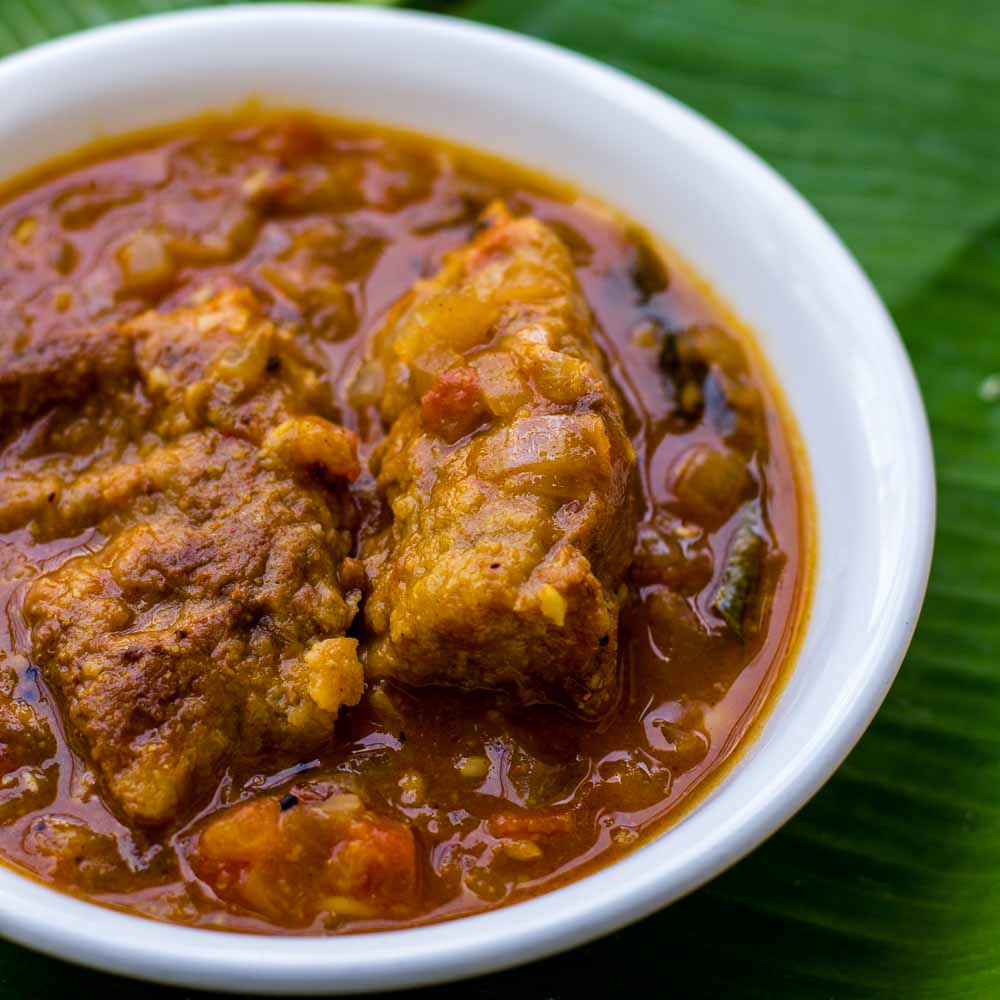
Chettinad style saiva meen kuzhambu or vegetarian fish curry. The fish steaks are made using cowpea – thattapayir and simmered in a tamarind gravy. It looks very similar to a traditional fish curry.
There are some recipes that are so fun to make and this is one such recipe. I made this for the first time years ago. There is no fish in this recipe. The cowpea – thattapayir patties are shaped and fried like fish and added to the curry. People truly believe that it is indeed the traditional South Indian fish curry. Years ago, Vinodh truly believed that it was fish curry until he took the first bite – the first time. I totally love the facial expression people make after taking the first bite of the fish curry. The curry tastes really good and its the fun part that makes this recipe a winner when you serve them to guests for the first time.
Here is the video of how to make saiva meen kuzhambu
We will be using thatta payir / cowpea – brown variety for making the faux fish steaks.

Cowpea – Thattapayir paste Soak the cowpea overnite in water. Next day, drain the water and grind the cowpea with fennel seeds, red chilli powder, salt and garlic cloves to a thick paste. Try not to add any water while grinding. Add 2 tablespoon of water if the mixie wont budge and make sure that the paste remains thick. Pulse several times if need be.

Steaming the Cowpea – Thattapayir paste Traditionally, the paste is steamed in a local leaf called “ lejjai ketta keerai “. Its also called as nanjundan keerai or lachakkottai keerai. Its widely used in cooking in the chettinad region. They even make a stir-fry with the leaves. Today I will be using banana leaves for steaming the paste. If you cant find banana leaves, you can even use parchment paper as a substitute.
Spread the paste on the banana leaf to form a rectangle. Cover the leaf gently over the paste.

Steam the leaf for 15 minutes in a steamer.

Once the paste has been fully cooked, remove the leaf from the steamer and cut the cooked paste into roughly about one inch cubes.

Frying the Thattapayir – Cowpea cubes Heat Oil in a pan until hot. Place the cubes gently in oil and fry them until crisp and golden brown. Drain the fried cubes on paper towels. Set aside. Tip: If the oil is really hot, the steamed cubes wont stick to the bottom of the skillet while shallow frying. Alternatively, one can use a non-stick pan to fry the cubes.

For the Gravy Heat sesame oil in a pan and add in the mustard seeds, fenugreek seeds and fennel seeds. Let the seeds splutter. Add in the chopped onions and fry till the onions are nice and soft and starting to brown.

Add in the chopped tomatoes, coriander powder, sambar powder, chilli powder and salt. Fry till the tomatoes are well cooked and juiced down. Add in the tamarind paste and two cups of water. I have used homemade tamarind paste today. Simmer the gravy for 10 minutes. Note: If using raw tamarind, soak a lime size tamarind in 2 cups of water for 20 minutes. Squeeze the tamarind in the palm to extract the pulp. Discard the seeds and use the tamarind pulp in the recipe. Homemade Tamarind Paste Recipe .

Add in the fried cubes and simmer for couple of minutes more.

The faux fish curry is ready. Do try it at home.

For the fish steak
- 1/3 cup cowpea / thatta payir
- 1/2 teaspoon fennel seeds (sombu)
- 1/2 teaspoon red chilli powder
- 1/2 teaspoon salt
- 5 cloves garlic
- 1/4 cup sunflower oil to shallow fry
For the gravy
- 2 teaspoon sesame oil
- 1/4 teaspoon mustard seeds
- 1/4 teaspoon fenugreek seeds (vendhayam)
- 1/2 teaspoon fennel seeds (sombu)
- 2 sprigs curry leaves
- 1 onion, finely chopped
- 2 tomatoes, chopped
- 2 teaspoon coriander powder
- 1 teaspoon sambar powder
- 1 teaspoon chilli powder
- 1 teaspoon salt
- 2 tablespoon tamarind paste
For the fish steaks
- Soak the cowpea overnite in water. Next day, drain the water and grind the cowpea with fennel seeds, red chilli powder, salt and garlic cloves to a thick paste.
- Spread the paste on the banana leaf to form a rectangle. Cover the leaf gently over the paste.
- Steam the leaf for 15 minutes in a steamer.
- Once the paste has been fully cooked, remove the leaf from the steamer and cut the cooked paste into one inch cubes.
- Heat Oil in a pan until hot. Place the cubes gently in oil and fry them on each side until crisp and golden brown. Drain the fried cubes on paper towels. Set aside.
For the Gravy
- Heat sesame oil in a pan and add in the mustard seeds, fenugreek seeds and fennel seeds and curry leaves. Let the seeds splutter. Add in the chopped onions and fry till the onions are nice and soft and starting to brown.
- Add in the chopped tomatoes, coriander powder, sambar powder, chilli powder and salt. Fry till the tomatoes are well cooked and juiced down. Add in the tamarind paste and two cups of water.
- Simmer the gravy for 10 minutes.
- Add in the fried cubes and simmer for couple of minutes more.
- Author: Kannamma - Suguna Vinodh
- Prep Time: 30 mins
- Cook Time: 30 mins
- Category: Curry
- Cuisine: Tamilnadu